On this page
- GLM is a whole food: EPA, DHA and the rare ETA, plus glycosaminoglycans, chondroitin and trace minerals.
- UC-II works through one mechanism, immune tolerance, and is an isolated compound from chicken cartilage.
- GLM's omega-3s act on both the COX-2 and 5-LOX pathways rather than one.
- GLM is poultry-free, which matters for dogs with chicken sensitivities.
- Mussels are filter feeders, so New Zealand mussel farming improves the water it grows in.

When it comes to supporting your dog's joint health, the supplement aisle can feel overwhelming. Two ingredients that come up again and again in discussions about canine mobility are green-lipped mussel (GLM) powder and UC-II collagen. Both have their supporters. At Colt's Woof we've made a deliberate choice to stock green-lipped mussel powder, and here's the reasoning.
Understanding the contenders
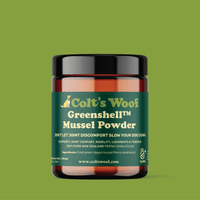
Green-lipped mussel powder comes from Perna canaliculus, a mussel species native to the coastal waters of New Zealand. This whole-food ingredient contains a combination of omega-3 fatty acids (including EPA and the rare ETA), glycosaminoglycans, vitamins, minerals, and naturally occurring chondroitin sulfate.
UC-II collagen is a patented form of undenatured type II collagen derived from chicken sternum cartilage. It works through a process called oral tolerization, in which the immune system is trained to stop attacking the body's own collagen in the joints.

The case for green-lipped mussel powder
1. Whole-food nutrition against an isolated compound
It is a complete whole-food ingredient. When you give your dog GLM, they're receiving a matrix of nutrients that work together. That includes:
- Omega-3 fatty acids: EPA, DHA, and the rare ETA
- Glycosaminoglycans: natural building blocks for cartilage
- Chondroitin sulfate
- Vitamins and minerals: zinc, copper, manganese
- Antioxidants
That profile means GLM doesn't address just one aspect of joint health. It supports several at once.
2. A broader effect on the inflammatory pathways
The omega-3 fatty acids in GLM, particularly the unusual eicosatetraenoic acid (ETA), have been studied for their effect on the pathways behind joint inflammation. Research shows GLM acting on both the COX-2 and 5-LOX routes, which is broader coverage than many single-mechanism supplements.
For dogs living with arthritis, inflammation is often the main source of pain and reduced mobility. GLM's several-angle approach is why it is studied as everyday support for comfort and mobility rather than as a treatment.
3. Cartilage support and joint lubrication
The naturally occurring glycosaminoglycans and chondroitin in GLM provide raw materials your dog's body uses to maintain and repair cartilage. These compounds also help maintain the viscosity of synovial fluid, the lubricant that keeps joints moving smoothly.
4. Sustainable and natural sourcing
New Zealand's GLM farms operate under strict environmental standards. The mussels are sustainably harvested from clean, unpolluted waters, and because mussels are filter feeders, the farming process actually contributes to water quality. For those of us committed to natural, chemical-free pet care, that matters.
5. Broader application
Where UC-II collagen works primarily through immune modulation, GLM offers benefits that extend beyond the joints. Its omega-3 fatty acids support skin and coat condition, cardiovascular function, and a normal, balanced inflammatory response throughout the body.
Understanding UC-II collagen's limitations
UC-II isn't without merit. It has shown effectiveness in clinical trials for osteoarthritis. But there are some considerations:
- Narrow mechanism of action. It works by training the immune system to stop attacking joint cartilage, which may not address every aspect of joint degradation.
- Sourcing. It is derived from chicken cartilage, which can be a problem for dogs with poultry sensitivities.
- Dosage precision. It requires very specific dosing, typically 40 mg daily, to be effective.
- Isolated compound. It lacks the wider nutritional support of a whole-food alternative.
The evidence
Multiple studies have looked at GLM for canine joint health. Research has reported improvements in mobility, lower pain scores, and better quality of life in dogs with osteoarthritis given GLM powder. The combination of effects on inflammation, cartilage support, and joint lubrication is what makes it a comprehensive option rather than a single-target one. The full reference list is at the foot of this article.
Our philosophy at Colt's Woof
At Colt's Woof we believe in the power of natural, whole-food ingredients. We've seen firsthand how GLM powder has helped dogs, including our own Colt and Elmo, keep their mobility and their zest for life. By choosing ingredients that work with your dog's body rather than trying to outsmart it with isolated compounds, we build supplements that support overall health while addressing a specific concern.
It also aligns with our commitment to chemical-free, naturally sourced pet care. The aim is steady support for the joints rather than covering up the signs.
Have questions about our supplements, or want to talk through whether green-lipped mussel powder suits your dog? Come find us at your local farmers market, or send us a message.
Sources
10 references- Bierer, T.L. & Bui, L.M. (2002). "Improvement of arthritic signs in dogs fed green-lipped mussel (Perna canaliculus)." The Journal of Nutrition, 132(6), 1634S-1636S.
- Pollard, B., Guilford, W.G., Ankenbauer-Perkins, K.L. & Hedderley, D. (2006). "Clinical efficacy and tolerance of an extract of green-lipped mussel (Perna canaliculus) in dogs presumptively diagnosed with degenerative joint disease." New Zealand Veterinary Journal, 54(3), 114-118.https://doi.org/10.1080/00480169.2006.36622
- Rialland, P., Bichot, S., Lussier, B., Moreau, M., Beaudry, F., del Castillo, J.R. & Troncy, E. (2013). "Effect of a diet enriched with green-lipped mussel on pain behavior and functioning in dogs with clinical osteoarthritis." Canadian Journal of Veterinary Research, 77(1), 66-74.https://www.ncbi.nlm.nih.gov/pmc/articles/PMC3524818/
- Hielm-Björkman, A., Tulamo, R.M., Salonen, H. & Raekallio, M. (2009). "Evaluating complementary therapies for canine osteoarthritis part I: Green-lipped mussel (Perna canaliculus)." Evidence-Based Complementary and Alternative Medicine, 6(3), 365-373.https://doi.org/10.1093/ecam/nem136
- Whitehouse, M.W., Macrides, T.A., Kalafatis, N., Betts, W.H., Haynes, D.R. & Broadbent, J. (1997). "Anti-inflammatory activity of a lipid fraction (lyprinol) from the NZ green-lipped mussel." Inflammopharmacology, 5(3), 237-246.https://doi.org/10.1007/s10787-997-0001-3
- Cho, S.H., Jung, Y.B., Seong, S.C., Park, H.B., Byun, K.Y., Lee, D.C., Song, E.K. & Son, J.H. (2003). "Clinical efficacy and safety of Lyprinol, a patented extract from New Zealand green-lipped mussel (Perna canaliculus) in patients with osteoarthritis of the hip and knee: a multicenter 2-month clinical trial." European Annals of Allergy and Clinical Immunology, 35(6), 212-216. Human study, cited for mechanism.
- Bui, L.M. & Bierer, T.L. (2003). "Influence of green lipped mussels (Perna canaliculus) in alleviating signs of arthritis in dogs." Veterinary Therapeutics, 4(4), 397-407.
- Coulson, S., Vecchio, P., Gramotnev, H. & Vitetta, L. (2012). "Green-lipped mussel (Perna canaliculus) extract efficacy in knee osteoarthritis and improvement in gastrointestinal dysfunction: a pilot study." Inflammopharmacology, 20(1), 71-76.https://doi.org/10.1007/s10787-012-0128-6
- McPhee, S., Hodges, L.D., Wright, P.F., Wynne, P.M., Kalafatis, N., Harney, D.W. & Macrides, T.A. (2007). "Anti-cyclooxygenase effects of lipid extracts from the New Zealand green-lipped mussel, Perna canaliculus." Comparative Biochemistry and Physiology Part B, 146(3), 346-356.https://doi.org/10.1016/j.cbpb.2006.11.001
- Eason, C.T., et al. (2018). "Greenshell™ mussels: a review of veterinary trials and future research directions." Veterinary Sciences, 5(2), 36.https://doi.org/10.3390/vetsci5020036
This article is for educational purposes and is not a substitute for individualized veterinary guidance. Talk to your vet about the right product and dosage for your dog.